What a fault gallery actually does for your product team
Spreadsheets summarise faults. Galleries let your product team see them. The difference shows up in your next manufacturing run.
On this page4 sections
Most product teams operating on Shopify see warranty data as a monthly PDF: top fault categories, claim rates by SKU, maybe a chart trending over time. That's useful. It's also two layers of abstraction away from the actual problem — and product decisions made on summaries are decisions made without evidence.
What a gallery shows that a report can't
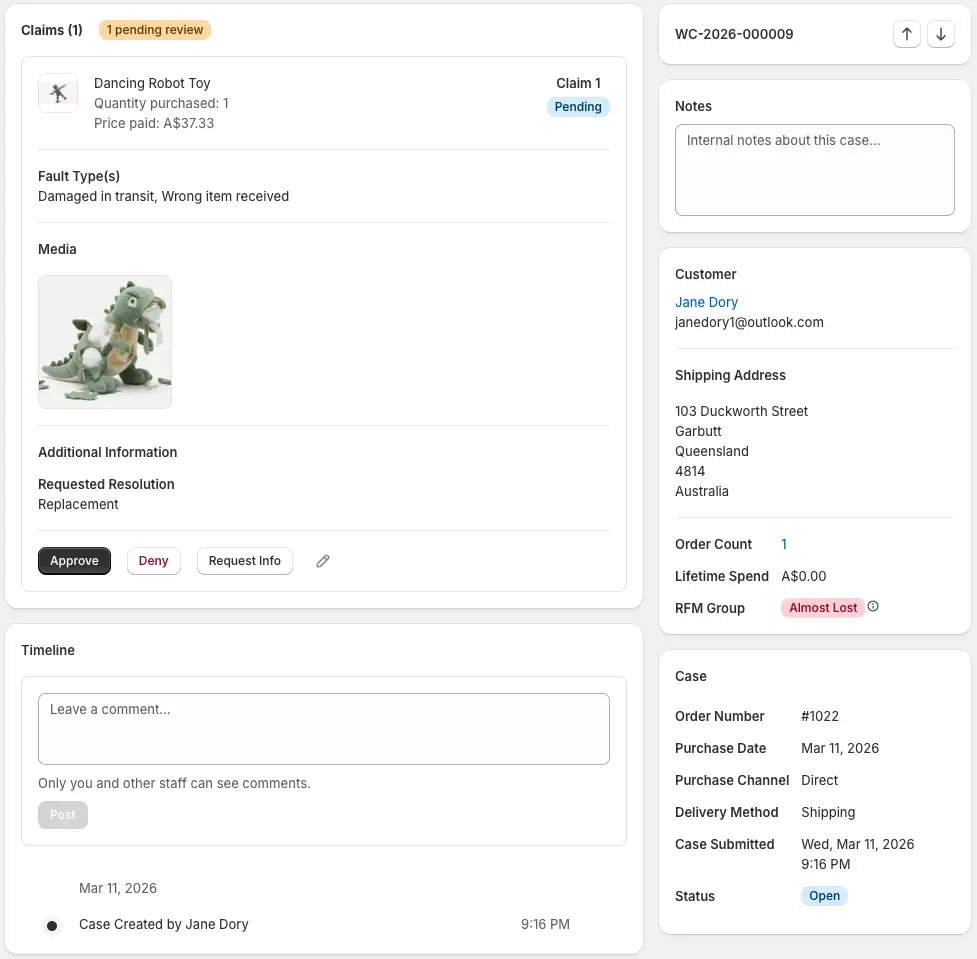
A fault gallery is just every customer-submitted photo and video, filterable by SKU, fault category, batch, and date. The first time a product manager opens it for a SKU with a rising claim rate, the conversation changes. Instead of "defects up 14% this month," it becomes "the zip teeth on this batch all misalign at the same point — that's a tooling issue."
The three questions a gallery answers in 60 seconds
- Is this fault real or operator interpretation? Photos remove ambiguity.
- Is it concentrated in a batch or distributed across production? Date filter answers this.
- Is the customer evidence consistent with our QA notes? Side-by-side comparison.
What changes when product can self-serve
When the analyst-built monthly cycle goes away, two things happen. Product investigates faster — usually within hours of a spike instead of weeks. And ops stops being the bottleneck on "can you pull me a list of every claim mentioning the strap?" That alone freed up ~6 hours a month of analyst time on our team.
It also changes the supplier conversation. Sending a manufacturer ten dated, customer-submitted photos of the same defect is materially different from sending an aggregated complaint. Suppliers respond to evidence.
What to look for when evaluating a gallery
- Multi-filter combinations (SKU + fault + date) without rebuilding a query
- Inline metadata: order date, customer comment, agent decision
- Direct link from gallery image back to the originating claim
- Export to share with manufacturers without manual screenshotting
Stop drowning in warranty tickets
Resolvi is built for Shopify brands that manufacture their own product. Structured fault claims, item-level decisions, automated Shopify execution.
7-day free trial · No credit card required · Install from Shopify App Store